
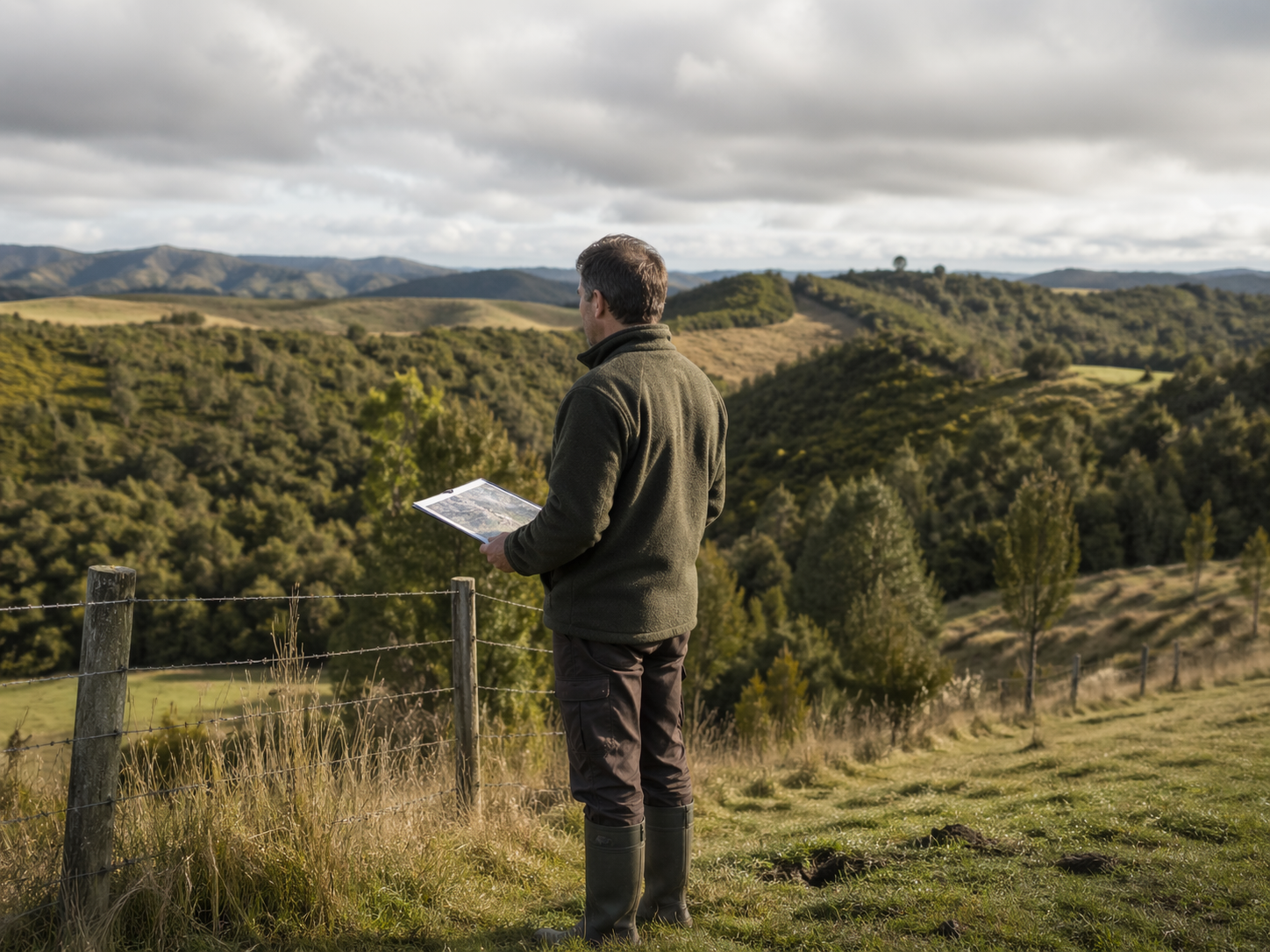
A practical decision guide to help NZ landowners assess whether registering eligible land in the NZ ETS is worthwhile given eligibility, costs, obligations, and long-term fit.
If you own land with regenerating bush, planted natives, or other forest potential, it is easy to jump straight to the exciting question:
How many NZUs could this land earn?
But for most landowners, that is not the best place to start.
The better question is this:
Should this land go into the NZ ETS at all?
That matters because ETS registration is not simply an opportunity to earn units. It is a long-term land-use decision with rules, evidence requirements, compliance tasks, and possible future liabilities.
For some landowners, registering eligible post-1989 forest land in the NZ ETS can be a smart move. For others, it may be better to wait, get the land assessed properly, or decide that registration is not the right fit.
Before you think about earnings, you need to know whether the land is actually eligible.
In practical terms, ETS forest land generally needs to:
This is where many landowners get caught out.
A block can look green and tree-covered without meeting the ETS definition of forest land. Narrow shelterbelts, scattered tree cover, or isolated patches under the minimum size can all fall short.
At the same time, some landowners underestimate what may qualify. Scrub or early native regeneration that looks unimpressive from a distance can sometimes still meet post-1989 criteria, especially once the evidence and site context are properly reviewed.
So before looking at NZU revenue, you need to answer a simpler question:
Does this land qualify as ETS forest land?
If the answer is no, the rest of the conversation stops there.
Once eligibility is on the table, the next big distinction is whether the land is pre-1990 or post-1989 forest land.
In simple terms:
That distinction matters because most landowners exploring carbon opportunities are really asking whether they have eligible post-1989 forest land.
If they do, they may be able to earn NZUs as the forest grows. But that does not mean they automatically should register.
This is probably the most important point in the whole discussion.
A block can be technically eligible and still be the wrong fit for registration.
Why? Because the ETS is not just upside.
Joining the scheme can involve:
That last point matters more than many people expect.
If units have been sold and later need to be repaid, the cost of buying them back may be much higher than the price they were sold for.
So the real question is not just:
Can I register this land?
It is:
Would registration actually make sense for this property and for what I want this land to become?
Before making an ETS decision, it helps to step back and be honest about your long-term goals.
Are you trying to:
These goals matter because the right ETS decision depends as much on landowner intent as on technical eligibility.
A landowner who wants long-term native regeneration is making a very different decision from someone who wants flexibility or may change land use later.
If your land is eligible post-1989 forest land, the next question is not just whether to join the ETS. It is also how to join.
The two broad pathways are standard forestry and permanent forestry.
Standard forestry is generally better suited to forests managed with harvest or rotation in mind.
It can be the right pathway in some situations, but it is not automatically the best fit for every landowner, especially if the real goal is long-term native forest restoration.
Permanent forestry is better suited to forests that are not intended to be clear-felled.
For many landowners focused on native regeneration, biodiversity, and long-term stewardship, this may sound more aligned with their goals. But it comes with a serious long-term commitment.
Permanent forestry must stay in that category for at least 50 years.
If that level of permanence does not fit your goals, you should be cautious.
A small block can qualify and still not be worth registering.
That is one of the most important practical realities for landowners.
As a rough guide:
That does not mean smaller blocks never make sense. It means scale affects how worthwhile registration is likely to be.
And size is not the only variable.
For indigenous post-1989 forest, one of the most overlooked issues is age at registration.
Landowners sometimes assume that if a block qualifies, it will automatically earn at a strong rate. In reality, sequestration can vary quite a bit depending on the age and condition of the forest.
A younger or older indigenous block may sit on a slower part of the curve than a landowner expects. That means two blocks of similar size may not look equally attractive once age profile is taken into account.
So when thinking about whether a block is a real ETS opportunity, it is not enough to ask:
You also need to ask:
A block may look more attractive when:
A block may look more marginal when:
That does not always mean “no”.
But it often means “check properly before committing”.
Before making a serious decision, landowners should gather clarity around:
For naturally regenerating native forest, the evidence side matters a lot. Historical imagery is often a key part of showing when regeneration began and whether the land meets the post-1989 test.
The smartest landowners do not ask only whether their land can go into the NZ ETS.
They ask whether it should.
That means looking at eligibility, scale, age profile, evidence, costs, obligations, land-use intent, and long-term fit together.
For the right property, ETS registration can be a powerful tool. It can help support native regeneration, reward long-term carbon storage, and strengthen the economics of restoration.
But it is better made carefully than quickly.
If your land may qualify, the best next step is usually to get it properly assessed before committing to registration. In practice, that can be especially useful where scrub or early regeneration may qualify, where the evidence is not straightforward, or where the block sits in a marginal size range.
MyNativeForest offers free eligibility assessments to help landowners understand whether a block is likely to qualify and what evidence may be needed before making a decision.


.jpg)